Friday, February 24, 2012

more citations

"Jacobus Cornelis Kapteyn." Encyclopedia of World Biography. 2nd ed. Vol. 8. Detroit: Gale, 2004. 436-437. Gale Virtual Reference Library. Web. 24 Feb. 2012.
Document URL
http://go.galegroup.com/ps/i.do?id=GALE%7CCX3404703452&v=2.1&u=fl_sarhs&it=r&p=GVRL&sw=w

APOD 3.6

See Explanation.  Clicking on the picture will download 
the highest resolution version available.

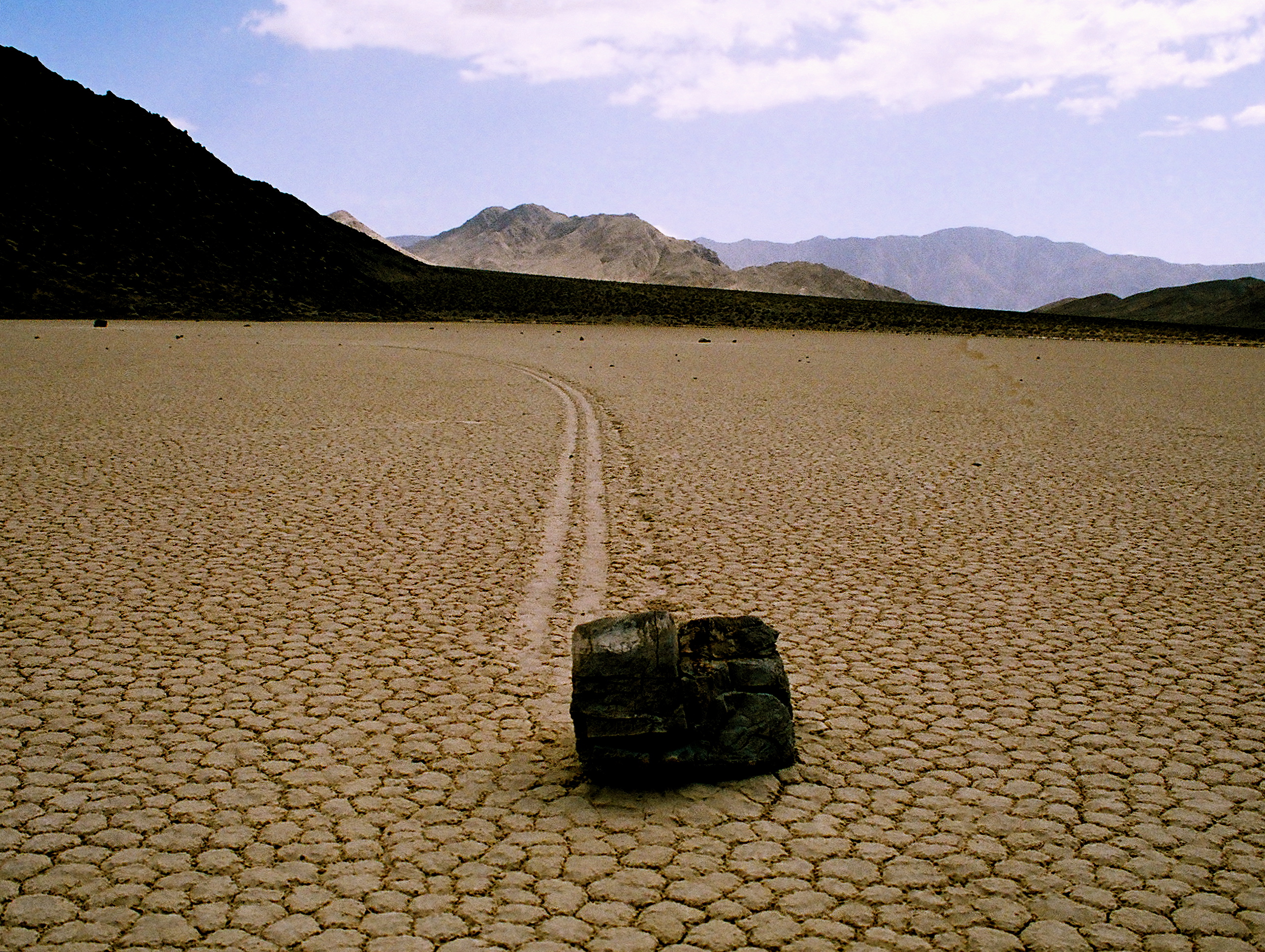
This rock was found in Death Valley in California. The valley is a dried river bed and is almost perfectly flat.The hypothesis of how they got to the middle of such a flat surface is that high winds after storms push these rocks across the valley. They are called sailing rocks. It is a funny idea that rocks up to 300 kg move across the surface. It adds another creepy and surreal affect to Death Valley.

Thursday, February 23, 2012

Work Cited

"The Bruce Medalists: Jacobus C. Kapteyn." The Bruce Medalists. 22 Feb. 2011. Web. 23 Feb. 2012. <http://www.phys-astro.sonoma.edu/brucemedalists/kapteyn/index.html>.
"Jacobus C. Kapteyn." NNDB: Tracking the Entire World. Soylent Communications, 2007. Web. 23 Feb. 2012. <http://www.nndb.com/people/657/000170147/>.
"Jacobus Kapteyn." Wikipedia. Wikimedia Foundation, 02 Oct. 2012. Web. 23 Feb. 2012. <http://en.wikipedia.org/wiki/Jacobus_Kapteyn>.

Star Formation

Hubble Panoramic View of Orion Nebula
Orion Nebula

Nebulas are the birth place of many stars. This one is the Orion Nebula. Stars are made up from dust clouds like this one, turbulaence deep within the cloud creats strong winds with sufficient mass. This allows the gas and dust to collapse under its own gravitaional attraction. As the cloud collapses the material at the center heats up, this hot core is known as a poststar. The hot core begins to gather dust and gas, growing in mass. remaining dust can form planets, comets, asteriods, or not form into anything. It is hard to study star development because it takes so long for them to form. It is predicted that it took our Sun 50 million years to reach a mature age. Scientists used to believe in a bottom-up theory that said that a small seed grew in size rather than gravitational collapse, a top-down theory. Becuase it is impossible for us to have seen a star form and mature or keep a study of a single star going for that long it is hard to say how stars really form.

Tuesday, February 14, 2012

Podcast

The Carina Constellation is one of the most likely canidates for a supernova explosions. It is in the Southern Hemisphere, it has one of the brightest stars in the middle of it and is much bigger and brighter than the Orian Nebula. Carina means keel of a ship. The nebula has an hour glass shape to it. the star almost exploded but didn't. It is 75 light years away. A lot of new stars are forming in it making it a much denser star region. Later in time it may look more like the Hiatees cluster only much greater. Aeta Carina may go Hyper Nova when it finally explodes sending off a lot of gamma rays. It has looked like it is going to go supernova serveral times. When it goes it will take out most of the other stars within the nebula leaving an empty gap. It is a truely amazing nebula it is beautiful and huge. It is a binary system so it is really cool and complex.

Friday, February 10, 2012

APOD 3.4

http://vimeo.com/36141149

This video displayes sequnces of auroras. I think auroras are really magical. Waves from the sun fire at us and our atmospheres catches them and it puts on a beautiful show. How does it produce such pretty colors and move across the sky like that? It looks like someone dumped color dye in water and it is seeping down to Earth. It is mind blowing how beautiful nature is and the things it can create. This video is really cool. It shows Auroras in Norway in different areas on different night with elapsed time.

Friday, February 3, 2012

APOD 3.3

See Explanation.
Moving the cursor over the image will bring up an annotated version.
Clicking on the image will bring up the highest resolution version
available.\
The scene is spectacular. It is really amazing when the visibility of stars is good and bright. This picture was taken in the Canary Islands, in theTeide National park. This landscape is used for testing future Martian rovers because of the volcanic landscape. When I went on vacation in the West, we went from Montana to Arizona. Out there the sky breath taking. We stopped at the Grand Canyon and spent a night. There were so many stars and I could see the milky way. Even more magnifisent was the Zion National Park. I saw three shooting stars while there and had never seen so many stars in my life. In Utah or Arizona we also went to an Observatory. I miss the night skies there, I really want to go visit that part of the states again.